
Sauces & Condiments
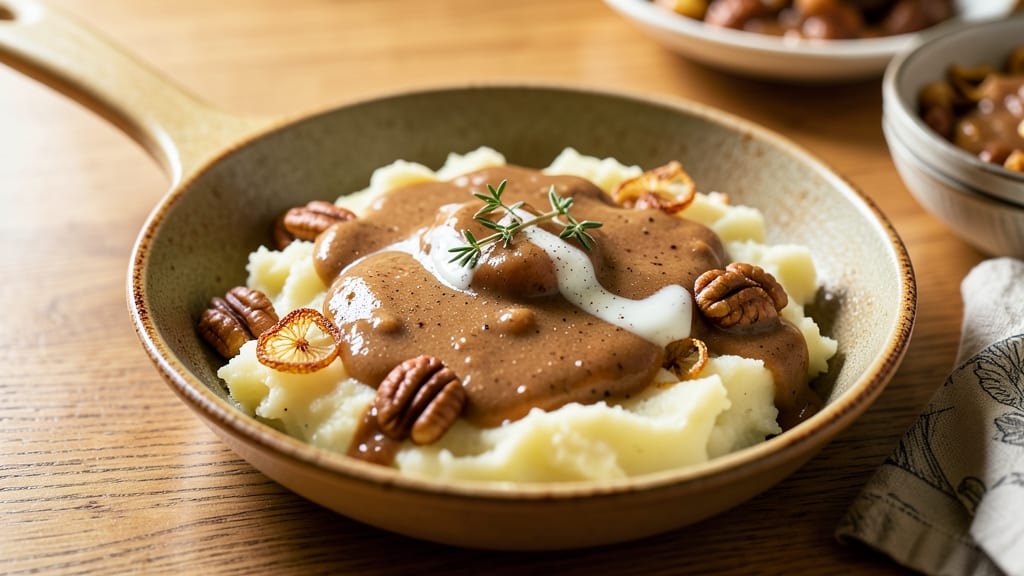
This apple butter gravy recipe transforms a simple pantry staple into a rich, spiced sauce with caramelized depth that elevates everything from mashed potatoes to roasted meats.
The key lies in balancing apple butter's natural sweetness with savory broth and a touch of cornstarch for that perfect, velvety texture—no lumps, just smooth, glossy perfection. What starts as a simmer becomes a fragrant, aromatic sauce that clings beautifully to any dish it graces.
What makes this gravy truly special is its versatility—it works as a standalone condiment for sandwiches or as a luxurious drizzle over holiday favorites. The spices (cinnamon, nutmeg, and a pinch of black pepper) create warmth that complements both sweet and savory dishes without overpowering them.
And unlike traditional gravies, this one requires no roux or constant stirring—just a few minutes of simmering for a foolproof result.
By the time you're done, you'll have a golden-brown, slightly thickened sauce with a caramelized edge that adds both texture and flavor. The apple butter's natural fruitiness shines through while the spices deepen its complexity, making it far more interesting than store-bought alternatives.
It's the kind of sauce that turns ordinary meals into something memorable—especially when paired with crispy biscuits or roasted pork.
Best of all, this recipe scales effortlessly—double it for leftovers or halve it for smaller servings. The secret to its success is patience during the reduction phase, where flavors meld into a harmonious balance.
Whether you're hosting a holiday feast or just craving something comforting, this apple butter gravy delivers restaurant-quality results with minimal effort.
Ingredients for apple butter gravy
Pantry staples and a few spices transform simple apple butter into a velvety, caramelized gravy masterpiece.
| Ingredient | Amount | Notes |
|---|---|---|
| Apple Butter 🍎 | ½ cup | Smooth, unsweetened preferred |
| Chicken Broth 💧 | 1 ½ cups | Low-sodium for flavor control |
| Heavy Cream 🥛 | ½ cup | Full-fat for velvety texture |
| Cornstarch 🌾 | 1 tbsp | For smooth thickening |
| Ground Cinnamon 🌿 | 1 tsp | Freshly ground for warmth |
| Ground Nutmeg 🌿 | ½ tsp | Freshly grated preferred |
| Ground Black Pepper 🌶️ | ¼ tsp | Freshly cracked for depth |
| Unsalted Butter 🧈 | 2 tbsp | Cold for caramelization |
| Brown Sugar 🍬 | 1 tbsp | Enhances caramel notes |
| Salt 🧂 | ¼ tsp | Diamond Crystal preferred |
The apple butter makes or breaks this gravy. Mowry's or Smucker's unsweetened varieties work best—they've got that deep, fruity flavor without overpowering sweetness. If you're using sweetened, cut the brown sugar to 1 teaspoon. For the broth, low-sodium is key—you want to control the saltiness yourself. The heavy cream should be full-fat; Trader Joe's or Organic Valley are my go-tos. As for spices, freshly ground cinnamon and nutmeg make all the difference—pre-ground tastes like sawdust. If you're feeling fancy, toast your spices in a dry pan for 30 seconds to deepen their aroma.
No apple butter? Applesauce plus 1/2 teaspoon cinnamon works in a pinch, but it won't have the same depth. Running low on heavy cream? Half-and-half at half the quantity keeps it creamy, though it won't be as rich. Out of cornstarch? Arrowroot powder is a 1:1 swap. The butter is non-negotiable for that caramelized edge—don't skip it. If you're making this ahead, store the dry ingredients (cornstarch, spices, brown sugar) separately until ready to use. The broth and cream can be refrigerated for up to 3 days, but the apple butter should be used fresh for the best flavor.
This gravy reheats beautifully—just warm it gently on the stove, stirring occasionally. It keeps for 5 days in the fridge, though the texture might thicken further. For longer storage, freeze in ice cube trays—perfect for adding richness to future meals. If it gets too thick when reheating, just whisk in a splash of warm water or broth. The secret to restaurant-quality results? Low and slow simmering—don't rush it. Patience pays off with that perfect caramelized depth.
Why You'll Love This Recipe
- Pantry Magic: I swear by this recipe—just open a jar of apple butter, heat some broth, and stir. No chopping, no peeling, no fuss. The only real step is thickening it with cornstarch, and honestly? That’s the hardest part of the whole thing.
- Warm Spice Hug: That first spoonful of apple butter gravy—smooth, sweet, with just a whisper of cinnamon—feels like a hug. The heavy cream makes it velvety, but the cinnamon keeps it bright and cozy. It’s the kind of flavor that sticks with you long after you finish.
- Game for Any Meal: Slather it over biscuits, drizzle it on roasted chicken, or spoon it into mashed potatoes. I’ve even used it as a glaze for pork chops. The richness balances perfectly with savory dishes, and the apple butter’s tang cuts through the heaviness of cream.
- Leftovers That Pay: This gravy thickens beautifully when reheated—just add a splash of broth or milk. I make a big batch on Sundays, and by Wednesday, I’m still scraping the last bits from the pan. Plus, the ingredients are cheap, so you’re not breaking the bank for something this satisfying.
Step-by-step instructions for apple butter gravy
Here's how to make a velvety-spiced gravy that balances apple-caramel richness with warm baking notes.
Melt Butter and Bloom the Spices
In a medium saucepan, melt the 2 tablespoons unsalted butter over medium-low heat until it foams and turns golden, about 2 minutes. Here's where the magic starts—I add the 1 teaspoon ground cinnamon, 0.5 teaspoon ground nutmeg, and 0.25 teaspoon ground black pepper all at once, whisking constantly for 30 seconds until fragrant.
This step is crucial because blooming the spices in fat releases their essential oils, which creates that deep, aromatic base. If you skip this, your gravy will taste flat. Watch the butter carefully—it should bubble gently but not brown. If it starts to darken too quickly, reduce the heat immediately.
Add Apple Butter and Brown Sugar
Whisk in the 0.5 cup apple butter and 1 tablespoon brown sugar until completely smooth. The mixture will thicken slightly as the apple butter melts into the butter. Let it cook for 2-3 minutes over medium heat, stirring frequently, until the apple butter fully incorporates and the mixture darkens to a rich amber color.
You're looking for a transformation here—the apple butter should go from its original color to a deep, caramelized hue. If it's not thickening enough, don't worry—we'll fix that in the next step. This caramelization step is what gives the gravy its signature depth and complexity, so don't rush it. The aroma should be warm and spiced, with a hint of apple.
Deglaze with Chicken Broth
Pour in the 1.5 cups chicken broth all at once, whisking vigorously to scrape up any browned bits from the bottom of the pan. Bring the mixture to a gentle boil over medium-high heat, then immediately reduce the heat to medium-low and let it simmer for 5 minutes. This deglazing step captures all the flavor that would otherwise stick to your pan.
The broth should be fully incorporated, and you should see a smooth, glossy sauce forming. If you notice any lumps or uncooked apple butter, whisk vigorously to break them up. This is also when you'll smell the full depth of the spices—warm cinnamon, earthy nutmeg, and a subtle apple undertone. If the gravy is too thin at this point, we'll fix it in the next step.
Thicken with Cornstarch Slurry
In a small bowl, whisk together the 1 tablespoon cornstarch with 2 tablespoons cold water until smooth. Slowly pour this slurry into the simmering gravy while whisking constantly. The gravy will thicken immediately—keep whisking for 1-2 minutes until it reaches a velvety consistency that coats the back of a spoon.
Here's the thing about cornstarch: it works best when added gradually to prevent lumping. If your gravy thickens too much, you can thin it with a splash of warm chicken broth. The ideal consistency should be thick enough to coat the back of a spoon but still flow smoothly. Taste and adjust the seasoning with the 0.25 teaspoon salt if needed—this is where you can really fine-tune the flavor balance between sweet, spicy, and savory.
Finish with Heavy Cream
Remove the saucepan from heat and stir in the 0.5 cup heavy cream. Let it sit for 1 minute to warm through, then give it one final taste. The cream should blend seamlessly, adding a luxurious richness that rounds out the spiced apple notes. If you want an extra touch of elegance, strain the gravy through a fine-mesh sieve to ensure absolute smoothness.
This gravy is best served immediately over roasted chicken, pork chops, or even as a dipping sauce for biscuits. The contrast of warm spices with the creamy texture makes it unforgettable. If you can't serve it right away, keep it warm in a slow cooker on the "warm" setting—just give it a quick whisk before serving to restore its silky texture.
Pro Tips For Making Apple Butter Gravy
- Whisk the Cornstarch: DESCRIPTION: Mix that cornstarch with cold heavy cream first—before adding it to the hot broth. I learned this the hard way when I dumped dry cornstarch directly into the pot and ended up with clumpy, sad gravy. A quick 30-second whisk in a separate bowl keeps things silky smooth.
- Simmer, Don’t Boil: DESCRIPTION: Keep the heat low once the cornstarch slurry is in. A rolling boil will curdle the heavy cream faster than you can say "apple butter disaster." You want a gentle bubble—just enough to thicken without scrambling the sauce.
- Warm the Apple Butter: DESCRIPTION: Stir a spoonful of hot broth into the apple butter first to loosen it up. Cold apple butter clumps like glue in gravy, and no one wants to scrape chunks out of their mashed potatoes. (Yes, even if you’re impatient like me.)
- Salt the Broth Early: DESCRIPTION: Taste the chicken broth before you start cooking—especially if it’s store-bought. Some brands are bland, and adding salt later won’t fix it. A pinch now means your gravy won’t taste like it’s missing something, no matter how much cinnamon you sprinkle on top.
Essential equipment for this recipe
Medium Saucepan
This is your workhorse for making apple butter gravy—3-quart capacity is ideal for this recipe. I use a Calphalon stainless steel saucepan because it distributes heat evenly and won’t react with acidic ingredients.
If you’re on a budget, Farberware Classic Stainless Steel works perfectly too. Avoid nonstick pans—they can’t handle the caramelization step as well, and the flavors won’t develop as deeply. 🔥
Whisk for Smoothness
A balloon whisk (like the OXO Good Grips) is essential for blending the cornstarch slurry and preventing lumps. The flexible wires ensure thorough mixing, especially when combining the cornstarch with cold water.
For the spice blooming step, I also recommend a silicon-coated whisk—it’s gentler on your hands and won’t scratch your pan. A French whisk works too, but it requires more elbow grease for the same results.
Fine-Mesh Sieve
If you want restaurant-quality smoothness, a fine-mesh sieve (like the OXO Good Grips) is a game-changer. Strain the finished gravy to remove any tiny apple butter bits or spice grit.
I keep one in my kitchen specifically for sauces—it’s worth the $15 investment. For a quick fix, a cheesecloth works in a pinch, but it’s messier and less consistent.
Measuring Spoons
Precision matters with spices and cornstarch—set of nested stainless steel spoons (like OXO Good Grips) ensures accuracy. The ¼ teaspoon measure is critical for black pepper, while the 1 tablespoon spoon is perfect for cornstarch.
Avoid plastic spoons—they wear out quickly and can harbor flavors. A spice grater (for nutmeg) and microplane (for cinnamon) elevate the process further by releasing more aroma.
Slow Cooker (Optional)
For keeping gravy warm during serving, a 3-4 quart slow cooker (like Hamilton Beach) is ideal. Set it to "warm" to maintain temperature without overcooking. This is especially useful for holiday meals where timing is tight.
If you don’t have one, a double boiler works—just place the saucepan in a pot of simmering water to keep it warm without direct heat.
Thermometer (For Perfectionists)
A kitchen thermometer (like Thermoworks Smoke) helps monitor the gravy’s temperature during simmering—aim for 195-200°F for that perfect velvety texture. It’s not mandatory, but it takes the guesswork out of consistency.
For a simpler approach, the "spoon test" works: dip a clean spoon into the gravy and let it drip back into the pan—if it forms a slow, steady stream, it’s ready. ✨
Nutrition facts
Frequently asked questions about apple butter gravy
Can I make this gravy without cornstarch?
Yes, but the texture will be thinner. For a cornstarch-free version, try whisking 1 tablespoon flour into the melted butter first, then cooking it for 1-2 minutes to create a roux before adding the broth. The gravy will be slightly thicker but still delicious! Alternatively, you can skip the thickener entirely for a more liquid consistency perfect for drizzling.
How can I adjust the sweetness level?
The recipe balances sweet and savory perfectly, but you can tweak it! For less sweetness, reduce the brown sugar to 0.5 teaspoon or use unsweetened apple butter. For more sweetness, add 1 extra teaspoon brown sugar or a pinch of cinnamon. Taste as you go—the spices help mask sweetness beautifully.
What are the best dishes to serve this gravy with?
This versatile gravy shines over mashed potatoes, roasted pork, biscuits, or even as a dipping sauce for cheese straws. It also pairs wonderfully with sausage and gravy, fried chicken, or as a glaze for ham. The warm spices make it a great companion for hearty fall and winter dishes.
Why did my gravy turn out too thin?
Thin gravy usually means the cornstarch didn't activate properly. Next time, make sure your cornstarch slurry is smooth and whisk it constantly while adding it to the simmering liquid. If it's already made, simmer uncovered for 5-10 minutes to reduce it, or whisk in 1/2 teaspoon more cornstarch mixed with water. Stirring vigorously helps thicken it faster.
Can I make this gravy ahead of time?
Store it in an airtight container in the fridge for up to 5 days. To reheat, warm it gently on the stove over low heat, stirring occasionally. If it thickens too much, whisk in 1 tablespoon warm water or broth. For longer storage, freeze in ice cube trays—thaw overnight in the fridge before using.